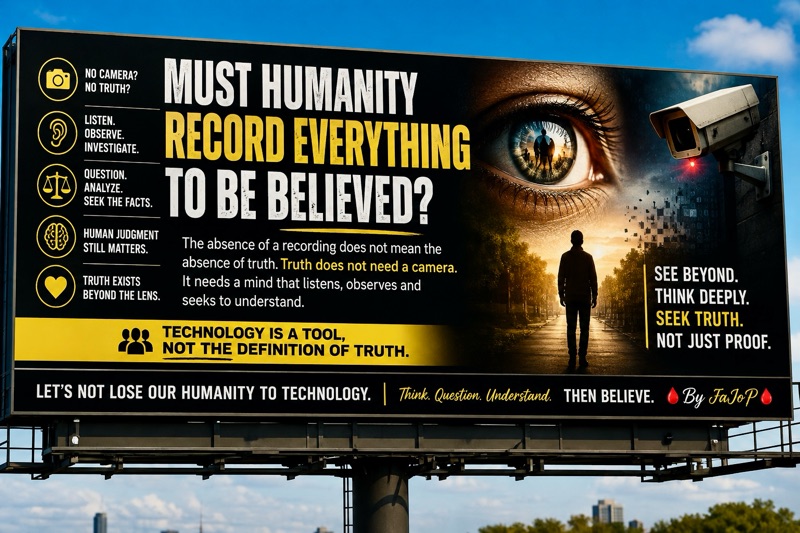
MUST HUMANITY RECORD EVERYTHING TO BE BELIEVED?
Should human beings have to walk around with surveillance cameras 24 hours a day simply because, whenever something happens, the first question we are asked is:
“Where is the evidence?”
Where is society heading?
Have we reached a point where the absence of a recording means there is no truth? Has a person’s spoken word become automatically meaningless simply because they cannot produce a video, photograph, document, audio recording, or some other form of evidence?
If that is where we are heading, then perhaps we should ask ourselves some uncomfortable questions.
Should married men and women be required to wear cameras everywhere they go? Should parents record every interaction with their children? Should neighbors constantly record one another? Should strangers carry cameras everywhere? Should every human being be expected to document every conversation, every interaction, every disagreement, and every moment of daily life—24 hours a day, even while sleeping—just in case something happens and they later need to prove it?
Isn’t that becoming absurd?
I understand the importance of evidence. In our legal system, evidence can be extremely important in determining what happened. It can help establish facts, expose wrongdoing, protect innocent people, and hold people accountable.
But I question the direction of a society in which technology sometimes appears to be replacing human judgment, observation, reasoning, investigation, and the simple ability to listen carefully.
There was a time when people listened.
They paid attention to conversations. They asked questions. They observed behavior. They investigated circumstances. They considered the credibility of the people involved. They compared different accounts. They examined motives, relationships, circumstances, and behavioral patterns before reaching conclusions.
Today, however, it can sometimes feel as though a person makes a statement and the immediate response is:
“Where is the proof?”
But what happens when there is no camera?
What happens when something occurs in a private place?
What happens when nobody was recording?
Does the absence of a recording automatically mean the incident never happened?
Of course not.
Yet we must be careful about creating a society where people feel they must constantly document their existence simply to protect themselves from not being believed.
WHAT HAPPENS WHEN THE “EVIDENCE” IS WRONG?
There is another question we should be asking:
How do we know the evidence being presented is genuine?
Technology is powerful, but technology is not infallible.
Documents can be forged.
Photographs can be manipulated.
Videos can be edited.
Audio can be altered.
Digital information can be fabricated, distorted, or taken completely out of context.
Even authentic material can sometimes be misleading if important context is missing.
So if technology itself can be manipulated, why should technology automatically be treated as the ultimate source of truth?
A recording may show what happened—but does it always show everything that happened?
A photograph may capture a moment—but does it explain everything that happened before or after that moment?
A document may contain words—but does the document itself prove that those words are truthful, accurate, complete, or legitimately created?
A digital file may appear authentic—but who created it, when was it created, why was it created, and has its authenticity been properly established?
These are questions that cannot always be answered simply by pressing “play.”
HUMAN JUDGMENT STILL MATTERS
This is why human judgment remains essential.
A fair legal system should not simply ask:
“Where is the evidence?”
It should also ask:
• Is the evidence authentic?
• Is it complete?
• Is it being presented in the proper context?
• Who created it?
• When was it created?
• Why was it created?
• Has it been altered?
• What circumstances surround it?
• What do witnesses say?
• Are the different accounts consistent?
• Are there contradictions?
• What does a thorough investigation reveal?
• Does the evidence make sense when considered alongside everything else?
Evidence should help establish the truth—not replace the search for truth.
Human beings have brains for a reason.
We can listen, observe, question, analyze, compare information, recognize inconsistencies, evaluate credibility, and distinguish between what appears to be true and what may actually be false.
That ability should not disappear simply because technology exists.
Technology should assist human reasoning—not eliminate it.
TRUTH DOESN’T REQUIRE A RECORD BUTTON
We should be careful not to create a society where the person with a camera is automatically considered more believable than the person without one.
Truth does not suddenly cease to exist because nobody pressed the record button.
A person should not have to document every second of their existence simply to prove that their experiences are real.
There must still be room for human testimony, investigation, observation, credibility, circumstances, reasoning, and common sense.
Of course, evidence matters.
But evidence itself must also be examined.
A piece of paper is not automatically the truth because it is printed.
A video is not automatically the truth because it is recorded.
A photograph is not automatically the truth because it exists.
An audio recording is not automatically the truth because it can be played.
A digital file is not automatically the truth simply because it appears authentic.
Everything presented as evidence must itself be evaluated.
That is part of the responsibility of a fair and thoughtful justice system.
TECHNOLOGY SHOULD SERVE HUMANITY—NOT REPLACE IT
We should not allow technology to become a substitute for human intelligence.
We should not lose the ability to listen carefully, ask meaningful questions, investigate thoroughly, examine circumstances, and determine credibility.
Because if human beings eventually lose the ability to distinguish truth from falsehood through careful observation, reasoning, questioning, and investigation—and instead simply accept whatever document, recording, photograph, or digital file is placed before them—then we will have surrendered something far more valuable than our privacy.
We will have surrendered our ability to think for ourselves.
Technology is one of humanity’s greatest tools.
It can preserve memories.
It can document events.
It can expose wrongdoing.
It can protect people.
It can help uncover facts.
But technology should remain what it was meant to be:
A tool for helping humanity discover the truth—not a replacement for human judgment and not the definition of truth itself.
Because sometimes the most important evidence is not something that was recorded.
Sometimes it is found in the people, circumstances, patterns, testimony, behavior, and facts surrounding what happened.
And perhaps the question we should be asking is not always:
“Where is the recording?”
Perhaps we should also ask:
“What happened—and have we done enough to genuinely find out?”
By 🩸FaJoP🩸


Comments
Post a Comment